



Think about your last packed house. The energy in the lobby afterward, the conversations, the buzz. Now consider this: roughly half the people in that room were there for the first time. And most of them won't be back.
Not because the experience failed them. But because of a number most organizations don't talk about enough.
It's not the box office total or the marketing budget. It's the proportion of your database made up of what TRG calls “Tryers”. These are people who visited once, maybe twice, and then disappeared.
Who are Tryers?
At TRG, we segment audiences not just by what they purchased, but by how deeply they're connected to an organization. We call this framework Advocates, Buyers, and Tryers. It's a loyalty pyramid that helps leaders see where their relationships are strongest and where they're most fragile.
"Tryers: From 1st Time to 2nd or Last Time to Now"
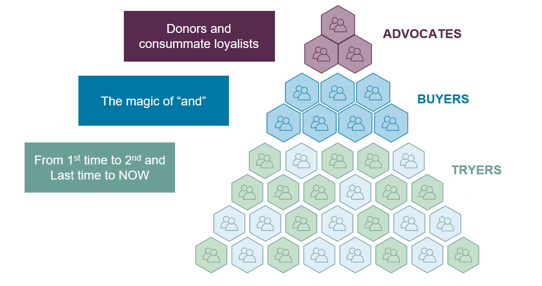
Tryers sit at the base of this pyramid. They're first-time attendees, infrequent visitors, and patrons returning after a long absence. Something motivated them to engage, but the more important question is what happens next:
- Will they come back?
- Will they begin to build a habit of participation?
- Or will they disappear after a single experience?
For most organizations, Tryers represent the vast majority of the database. They're also the least loyal, the most expensive to acquire, and the most likely to lapse if left unattended.
90% of your database. One visit. Gone.
When we study this across hundreds of organizations, regardless of region or business model, the number of Tryers in a database consistently starts with a nine. More than 90% of every database we look at falls into this group. And the vast majority of those 90% are one-and-done first-timers who never came back.
Watch this clip from the latest episode of Leading the Way as Brad, Christina, and Jill unpack what this 90% actually looks like, and why most teams don't realize it's happening.
Why Knowing Your Number Matters
The issue isn't that Tryers exist in your database. Every organization needs new people coming through the door, and that's healthy. The issue is what happens when you don't know how many of them are leaving, and you haven't built anything intentional to bring them back.
When you're not watching that number, something else takes over:
-
Your programming teams end up under constant pressure to find the next big blockbuster that attracts new audiences and fills seats.
-
Your marketing budget gets consumed by the cost acquisition, finding new audiences to replace the ones that quietly walked away.
-
Your financial model starts to depend on taking big swings on blockbusters that attract first-timers but often deliver thin margins.
It's exhausting. It’s expensive. And, you’re spending more to stand still.
Start with the question, not the answer
The practical steps (how to build a welcome strategy, which channels work best, what kind of offers actually change behavior) are all things we'll be exploring over the coming weeks. But the starting point is simpler than any of that.
Know your number:
What proportion of your first-time buyers actually come back?
If you don't know, you're not alone. Most organizations don't. But it's hard to fix something you're not measuring.
That's the first step. Everything else follows from there.
Hear the full conversation
This post draws on the latest episode of Leading the Way, where we dig into the Tryer segment in detail: who they are, why they matter, what the data tells us across regions, and the practical steps leaders can take to start shifting the number.
If any of this feels familiar, it's worth a watch.
.png?width=8138&height=4320&name=S3%20Ep2%2c%20released%204%20PLAY%20Landscape%20(3).png)