



Most pricing decisions for a season are made before anyone knows how that season will sell. You set your scales in the spring, publish, and then watch demand arrive in a shape nobody predicted: a Tuesday that sells out, a Saturday that doesn't, a title that catches a news cycle in week three. By the time you can respond, the performance has gone.
Dynamic pricing is the obvious answer to that, and it makes a lot of arts organizations uneasy, and for good reason. Nobody in this sector wants to read their own name in a story about surge pricing. Nobody wants to explain to a subscriber of fifteen years that a walk-up paid less than they did.
Both of those things are true at once, and the gap between them is where the real question sits. Not whether to price dynamically, but whether a tool can move fast enough to matter while still honoring what you've promised your patrons.
That's exactly why we've partnered with DynamO Pricing and we couldn't be happier with the fit.
Sold-out Saturdays, half-empty Tuesdays
If you've been doing this a while, you probably have a good sense of which nights won't sell. You knew in the spring, when you set the prices.
How many people want to come, on which night, at what price, isn't just something that happens to your organization. It follows from what you charged, who got rewarded for booking early, whether an affordable seat was still there at week three, and how fast anyone spotted the title that caught fire. Call that demand.
Sustainable revenue doesn't come from waiting to see how much of it turns up. It comes from shaping it deliberately, across the whole year.
That's been our discipline since long before the term “dynamic pricing” entered the vocabulary of arts and culture. We've helped organizations create demand from the ground up and optimize the demand they already have, so it converts into revenue and relationships rather than empty seats. Pricing has always been part of that work, and an often labor-intensive (though worthwhile) part, because real demand doesn't hold still. It shifts by performance, by week, by what's trending in the news.
Get it wrong and the cost shows up commercially too: revenue quietly left on the table when a hot ticket is underpriced, or a scramble into reactive discounting when a house won't fill. Managing it well, by hand, across a full season, is a critical (though time-intensive) task for teams.
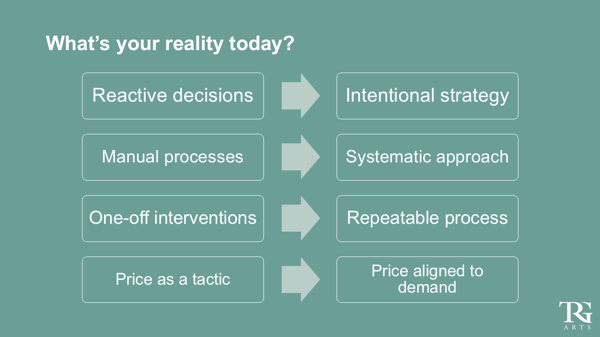 How TRG frames the shift to real demand management for clients.
Strategy and speed, together
This is where dynamic pricing technology earns its place in the demand management toolkit. Done well, it enhances the strategy. It gives the pricing lever more speed and more precision than a person repricing by hand ever could. It can notice a shift in demand the moment it happens. A holiday weekend, a snow day, a Tuesday night when the box office has gone home, not hours or even days later at the next scheduled review. And it can adjust more quickly, and with much more granularity, than is possible with manual adjustments.
Both demand management and dynamic pricing can drive immediate and long-term revenue growth when deployed separately.
Demand management shapes who buys, when, where, and on what terms, employing strategies that build not only revenue but loyalty and sustainable growth. Dynamic pricing ensures every ticket is priced closer to what the market will actually bear in the moment, with maximum efficiency. Put them together, a deliberate demand management strategy expressed through pricing that reacts in real time and the impact compounds. The gains aren't simply additive, they build on each other, season after season, as better pricing decisions feed better demand data, which in turn sharpens the next season's strategy.
Not all dynamic pricing tools are created equal
The differences between dynamic pricing tools matter, more than most vendors let on. A tool that only optimizes for per-ticket yield, without regard for anything else, can absolutely raise short-term revenue while quietly eroding the things that make that revenue sustainable.
That difference isn't only technical, either. It's a matter of mindset. Some providers are genuine partners who understand what a mission-driven organization is trying to protect; others are profit-chasing vendors who treat arts and culture as just another vertical to extract yield from, with little regard for the mission behind the box office.
True demand management asks pricing to do more than chase the highest number. It has to honor and incentivize the loyalty of subscribers and members who've supported an organization for years. It must protect accessibility, so that flexible pricing never becomes pricing exclusion. And it should respond to demand fluctuations in a way that keeps ticket volume moving upward, not just average price. Because a fuller house building deeper relationships is worth more, long-term, than a handful of seats sold at a premium.
Why we chose DynamO
We partnered with DynamO Pricing because they believe in these important principles just as we do. That shared ethos shows up in how the platform is actually built, not just in how it's marketed.
-
Guardrails you set. DynamO operates inside limits each organization defines. In practice, that means floors and ceilings by seating zone; a cap on how far a price can move in a single step; a rule that no public price falls below what a subscriber paid; and inventory held back from dynamic pricing altogether for access programs, school performances, and community nights. These aren't exceptions someone reverses manually after the fact. They're the conditions the algorithm works within. You decide the what, when, and why. The technology supplies the pace.
-
Paid only when you earn more. DynamO charges commission rather than a license fee, so it's paid out of incremental revenue, not regardless of results, meaning any uplift it drives lands with you already net positive, not as a break-even bet.
-
Live in weeks, not months. Integrations with Tessitura, Spektrix, Tickets.com, and about a dozen other platforms are already built, so there's no infrastructure overhaul. What you need to bring is clean sales history, your price scales, and someone internally who owns pricing decisions.
Built by a cross-disciplinary team of developers, data scientists, and economists who specialize in pricing specifically, DynamO carries a track record earned across nearly 100 arts, culture, sports, and live event organizations, pricing more than 15,000 events a year and completing close to three billion price updates, recognized as 2026 Disruptor of the Year at TheTicketingBusiness Awards.
Results that reflect our values
On average, organizations partnering with DynamO see a 12–16% revenue uplift on their dynamically priced tickets, with exceptional clients reaching 30% or more. What convinces us isn't the number alone. It's that it's achieved without compromising the parts of demand management we care about most: the relationships, the access, and the full houses that make revenue sustainable rather than a one-season spike.
A dozen of our clients are already using DynamO, with our team helping translate their pricing philosophy into the guardrails the platform runs within, and the early results are encouraging: double-digit average revenue uplifts and multiple dollars back for every dollar invested, achieved within the guardrails each organization set, not by loosening them. A 500-seat Pacific Northwest theatre company is a good example of what that looks like in practice:
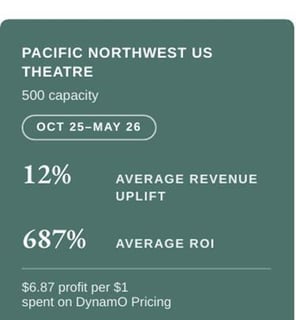
Source: TRG Arts and DynamO Pricing, 2025 client results.
A partner we're proud to recommend
We're proud to recommend DynamO as the dynamic pricing partner we believe in. If you're ready to see what it could mean for your season, let's talk: book time with our team to walk through your pricing data and guardrails, or find an upcoming session on our events calendar.