



Every arts organization has a version of the same conversation. Ticket sales were strong, the run went well, the campaign worked. Then the next season opens and almost none of those people come back.
That is not a marketing failure so much as an unexamined business model. The people who came once and disappeared are the largest group in your database by a wide margin, and understanding them is the clearest lever most organizations have.
Jump to the five questions we think leader should be asking about Tryers.
What is a Tryer?
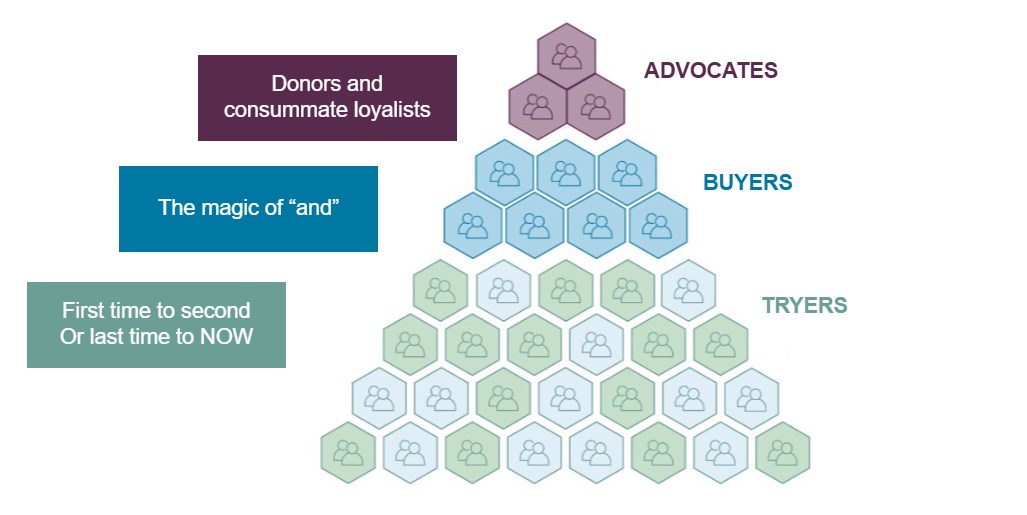
A Tryer is a patron whose pattern of engagement lacks consistency and frequency. Tryers sit at the base of the loyalty pyramid, below Buyers and Advocates.
| Tier | Share of a typical database | Share of revenue | Defining trait |
|---|---|---|---|
| Advocates | Under 2% | Roughly 30-40% of annual revenue in many organizations | The longest, most stable, most personal relationships |
| Buyers | 5–10% | Meaningful and growing | The "magic of and" |
| Tryers | Over 90% | Varies sharply by region | Infrequent, often one-and-done |
The critical point is that a Tryer is defined by behavior, not by transaction label. The Advocate–Buyer–Tryer framework segments patrons on recency, frequency, monetary investment, and whether that investment is stable or growing. So a single-ticket buyer, a subscriber, and even a donor can all be Tryers if the overall pattern lacks consistency.
That has an uncomfortable corollary: a single large gift does not by itself move a household out of the Tryer segment. Without recurring, dependable engagement, even a substantial one-time contribution is Tryer-level behavior. The framework measures relationship consistency, not transaction size.
How many Tryers does a typical arts organization have?
Over 90% of database records, consistently, across every database TRG studies, independent of region or business model. The majority of that group are "one-and-done": first-time attendees who transact once and never return.
Why does the Tryer segment matter so much?
Because database volume and revenue concentration are two different things, and the gap between them differs sharply by market.
In North America, more mature subscription, membership and individual philanthropy programs mean Tryers represent a smaller (though still meaningful) share of revenue relative to their share of the database: roughly 30-35%.
In the UK, weaker loyalty infrastructure means the Tryer segment drives a much larger share of both volume and revenue, closer to 80%, concentrating financial risk in the least stable part of the database.
The strategic implication is therefore different depending on where you are. North American organizations have room to grow revenue contribution from an already large but under-monetized Tryer base. UK organizations have a parallel opportunity: to build out the membership, multi-buy and structured philanthropy programs that create a stronger Buyer and Advocate base above the Tryer layer.
Why do so few first-time attendees return?
Across many organizations, roughly 75–85% of first-time attendees never return for a second visit, one of the most consistent and least addressed statistics in the field.
Organizations frequently treat that churn as an acceptable cost of doing business, offset by a steady stream of new first-timers. It is a costly assumption. The pattern is best described as a hole in the bottom of the bucket: without deliberate attention to retention, marketing and acquisition investment leaks out continuously, and the organization never gets ahead of it.
What does over-reliance on Tryers actually cost?
It carries structural risk, not just marketing inefficiency.
Depending heavily on Tryers typically requires heavier programmatic risk-taking (chasing blockbuster titles to keep attracting new first-timers) at high acquisition cost and often thinner margins.
Tryers also have the lowest average household revenue of any segment, and the marketing investment needed to move them forward is significant relative to their individual value.
But the alternative is worse. Acquiring an entirely new buyer for every engagement costs more still. Patrons who have already attended once, or who attended previously and lapsed, are the most efficient growth opportunity available to most organizations, the acquisition cost is already sunk.
Why isn't the commercial model a fair comparison?
It is tempting to benchmark against commercial theatrical producers who run profitably on high volumes of single-ticket buyers. The comparison can be a little misleading.
Commercial productions are typically single-product businesses that exist to bring one show to one theater, often for a defined run. Nonprofit and receiving venues are fundamentally different: they are relationship businesses that depend on delivering multiple products, across multiple years, to a base of returning patrons. This is why pricing, offers and inventory strategy cannot simply mirror commercial practice.
The difference creates real tension when nonprofit venues host commercial touring productions. Producers are focused on maximizing revenue within a single, time-limited engagement; venues are focused on the long-term health of their own database and community relationships.
The way through is early, transparent communication, helping producers see how first-time buyer cultivation, membership value and structured discounting ultimately support demand for their own engagements rather than compete with it. Venues that can demonstrate strategic control of their marketing engine gain a real advantage when competing with peers for major touring work.
How do you retain more first-time attendees?
| Lever | What it means in practice |
|---|---|
| Retention begins at the moment of purchase | Not a post-show activity. The arc runs from pre-show preparation and communication, through a deliberate welcome or acknowledgment at the point of attendance, to prompt, personalized outreach immediately afterwards with a clear invitation to return |
| Frame the relationship, not the transaction | A generic "rate your experience 1–10" survey is less effective than a personal, well-timed invitation that references specific details of the shared experience. The most effective communications recall the experience before asking for the next one |
| Use multiple channels together | No single channel consistently outperforms the others. Direct mail, email, phone and digital retargeting each contribute, and combining channels for one invitation consistently beats relying on any one alone |
| Treat offers as attention-getters, not motivators | Testing across many organizations shows a meaningful share of retained patrons never redeem the offer that prompted their return — often fewer than half. The offer's job is to capture attention, not to be the deciding factor. Time-bound offers, priority access to in-demand inventory and added-value experiences can work as well as straight discounting |
What should leaders be asking?
- Know your number. Quantify what share of your database (and separately, what share of your revenue) sits in the Tryer segment, and track both over time.
- Build accountability around retention. Create incentives for staff to invest time in first-time and lapsed patron outreach, not only in new acquisition.
- Interrogate the ROI of current spend. Assess honestly whether marketing and staff time aimed at acquiring, retaining or reactivating Tryers is going to the highest-return activity.
- Evaluate patrons by relationship stage, not transaction type. A subscriber, a donor and a single-ticket buyer can each be a Tryer. The framework should shape strategy more than the label does.
- Challenge the business model itself. Heavy structural reliance on an inconsistent, high-cost, low-renewal segment is a leadership and strategy question, not a marketing execution question.
Go deeper
The full conversation is in the Leading the Way episode One-and-Done: Why 90% of Arts Audiences Never Come Back, where the TRG team works through why retention fails and what to do about it.
.png?width=8138&height=4320&name=S3%20Ep2%2c%20released%204%20PLAY%20Landscape%20(3).png)